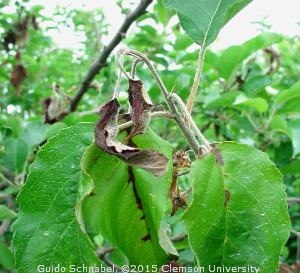
Fire blight is one of the most devastating and difficult to control diseases of fruit trees such as apple and pear. Unfortunately, this spring’s wet, cool weather has been conducive to fire blight. This disease is caused by a bacterium (Erwinia amylovora) that can spread rapidly when environmental conditions are right for disease development.
The bacteria can enter plants through the flower blossoms or wounds (such as those caused by wind or hail damage). Infected flowers or leaves turn black and die. The disease moves down the branch resulting in the death of young twigs which blacken and curl over. Leaves on affected branches wilt and blacken but remain attached to the branch giving the plant a fire-scorched appearance. If you look closely at the bark, slightly sunken areas called cankers appear on branches and the main stem. Insects and rain can spread the disease from plant to plant.
Fire blight is most commonly seen on apples and pears although other plants such as crabapple, pyracantha, hawthorn, photinia, quince and loquat can also be affected. There is no cure for fire blight so disease prevention is extremely important. When choosing plants, select varieties that are less susceptible to fire blight. Avoid excessive nitrogen fertilization which can result in succulent growth that is susceptible to disease.
Bradford pear (an ornamental pear) is fairly resistant to fire blight. When infected, Bradford pears tend to compartmentalize the disease well losing only inches of branches to the disease in a season. However, these cankers can serve as a reservoir of disease for subsequent seasons. Susceptible varieties of pears and apples can see substantially more damage.
Preventive spraying in early spring with streptomycin or copper based fungicides is possible in a commercial orchard setting. However, for most homeowners the cost and effort is not reasonable. Trees need to be sprayed at a 3 to 4 day interval during bloom and the entire leaf canopy must be treated for control.
You can reduce the spread of fire blight by removing and destroying all affected plant parts after the window for disease development is past. A warm dry period during the summer or during the winter dormant season are good times to prune. Pruning cuts should be made a minimum of 8 to 12 inches below any sign of affected tissue. Dispose of all infected prunings away from the orchard and sanitize pruning shears between cuts. A 10% household bleach solution or Lysol can be used to dip the pruners between cuts and reduce disease transmission. If not pruned out, these cankers will continue to spread the disease in subsequent seasons.