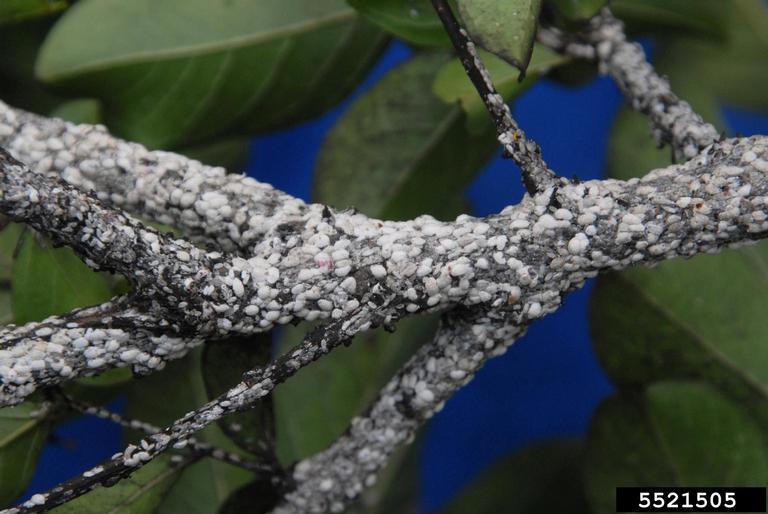
For several years, I've been hearing that crape myrtle bark scale was heading towards North Carolina. Well, now we know that it is here. This is bad news because crape myrtles are typically a tough and low maintenance tree, but trees infested with crape myrtle bark scale will require pest management to stay healthy and beautiful.
Scale are small insects that live and feed on plants but they are not easy to recognize as insects. Scale are circular to oval, wingless and lack a recognizable head, legs or other body parts. They are also largely immobile - feeding on the plant by sucking sap from the vascular system and staying in one location. Their waxy outer coating makes them look white. Light infestations will look like small, white bumps on the bark of the plant while heavier infestations can look like felt mats. As they feed, scale excrete large amounts of honeydew (a sugary liquid) which coats the leaves and limbs of the crape myrtle. This leads to the development of sooty mold (a black fungus) that grows on the honeydew. Most people will notice the sooty mold before they notice the scale insects themselves. Aphids can also cause sooty mold development so it is worth taking a close look at affected trees to determine which insect is the culprit.
Unfortunately, control of crape myrtle bark scale is going to be a challenge. Avoid buying and planting infested crape myrtles. Inspect plants closely before purchase. Once crape myrtle bark scale are found in the landscape, careful choices should be made in regards to insecticide use. Crape myrtles bloom continuously throughout the summer and attract a large number of pollinators making careful choice and application of insecticides critical. When using any pesticide, always read and follow all label directions.
For more information on this pest, visit: https://entomology.ces.ncsu.edu/2020/04/time-to-scout-for-crape-myrtle-bark-scale/#:~:text=Crape%20myrtle%20bark%20scale%20is%20a%20felt%20scale%20related%20to,and%20begin%20producing%20white%20filaments.